When it comes to food photography, composition often becomes the most challenging part. With a myriad of elements to consider—props, lighting, colour, placement—it’s easy to feel overwhelmed. Together with my friend and fellow food photographer, Bea Lubas, I’ve distilled our go‑to advice into four essential composition tips that you can apply right away to make your food images feel more natural, deliberate and visually engaging.
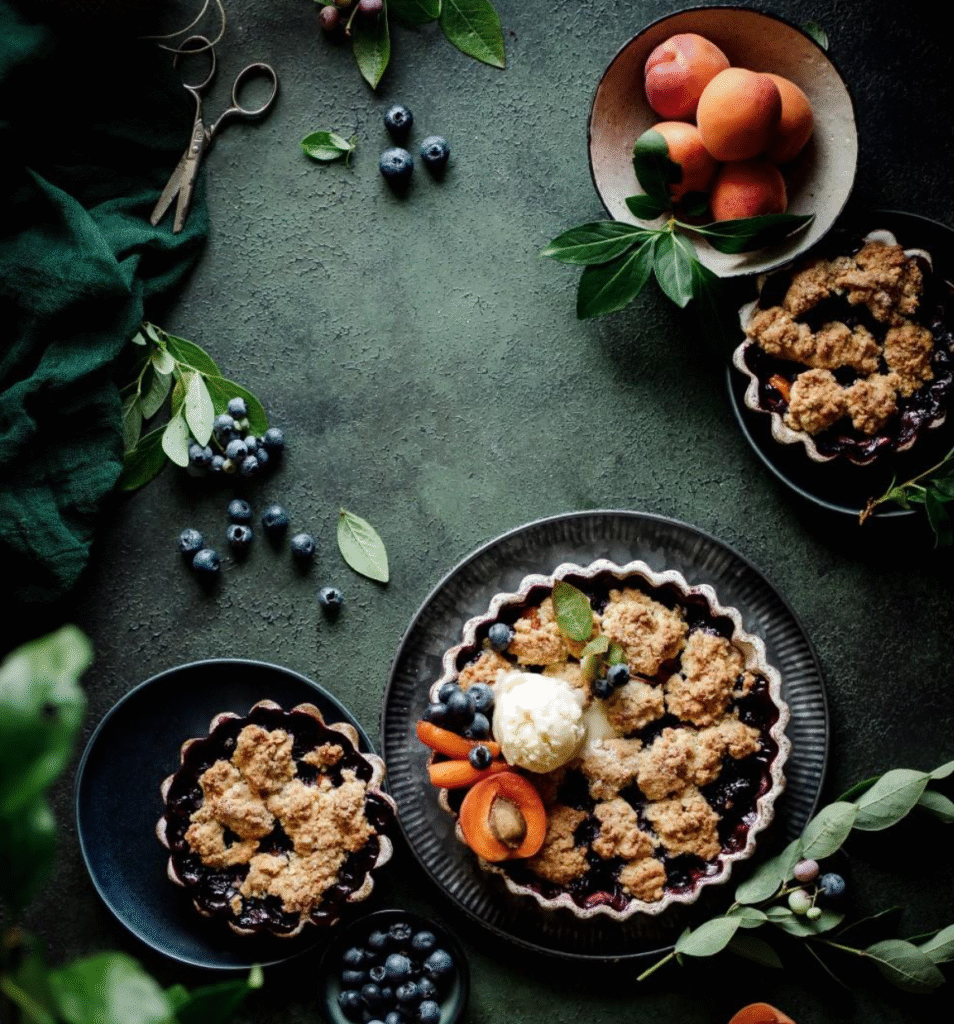
1. Create a Sense of Flow
One of the key goals in food photography is to guide the viewer’s eye smoothly through the frame—and ultimately land on your main subject. I call this “flow.” A formation that feels static or disconnected will pull the viewer out of the moment; instead, you want a visual journey. A very effective tool for this journey is curves. These are invisible lines that you shape by arranging your dishes, props and elements in a harmonious progression inside the frame.
You may have heard of S‑curves or C‑curves—yes, they’re part of it—but in truth any gently meandering line or arrangement that feels natural will achieve the same effect. The idea is to let the eye glide along these arcs, from one element to the next, through to your key subject. The moment the viewer arrives there feels satisfying. The trick is to resist the temptation to line everything up in rigid straight lines. Embrace the flow.
2. Choose Your Colours
While composition is structural, colour plays emotional harmony. Bea emphasises that one of the most powerful techniques is matching your props and background in a consistent colour palette. That might sound like it reduces variety—but in fact it does quite the opposite: by keeping setup colours unified, you allow the food itself to pop, even when many supporting items are present in the frame.
When selecting your palette, ask yourself two questions: What colour helps enhance the food? What sort of contrast or mood do I want? High‑contrast colour pairings produce energy and punch. Low‑contrast, monochromatic or tonal setups create softness and subtlety. Also, don’t dismiss colour psychology: the hue you choose can evoke specific emotions or atmospheres that consciously or unconsciously resonate with the viewer.
3. Add Some Negative Space
Often overlooked but deeply effective: negative space. This is simply the area where nothing is placed—empty, open, breathing. In busy scenes it acts as a visual counterbalance. In minimalist setups it is the quiet that surrounds the subject and helps the eye relax. I favour intentionally leaving some empty space around the main subject—not because it’s a waste, but because it gives the subject room to stand out and lets the viewer’s eye rest.
Finding the right level of negative space is an act of subtle calibration; it may take a little experimentation. But once you find it, you’ll notice that the whole composition feels less intense, more relaxed—and the main subject appears ever more present.
4. Create a Sense of Depth
Flat imagery rarely excites. What brings an image to life is depth. That feeling of layers, of foreground‑to‑background, invites the viewer into the scene, rather than simply letting them stare at it. Bea recommends placing elements across different planes—some in the foreground, some in the midground, some in the background. Overlapping these items works especially well: the tops of a stack of bowls, a spoon trailing into the frame, a blurred garnish in the front—all of that helps you build dimension.
By varying size, focus and placement, you create a hierarchy of interest: first what the eye notices, then what it wanderingly explores, then perhaps what it discovers in the blurred background. This layered approach makes compositions feel more natural and dynamic rather than constructed and flat.
Composition is a subtle yet profound art. It isn’t just about filling a frame; it’s about telling the right visual story. By thinking in terms of flow, colour, negative space and depth, you’ll be better equipped to craft images that feel considered yet effortless.
If you’re ready to practise these principles, we’d love for you to join our upcoming three‑day composition challenge, where we’ll dive even deeper into these topics and provide a guided path to improvement. Let your food photography breathe, flow, and invite viewers in.